A flat hologram opens a window onto depth. A ghost steps onto an empty stage. LEDs stretch into an endless tunnel. Choose optical holography or explore the reflections and projections behind apparent presences.
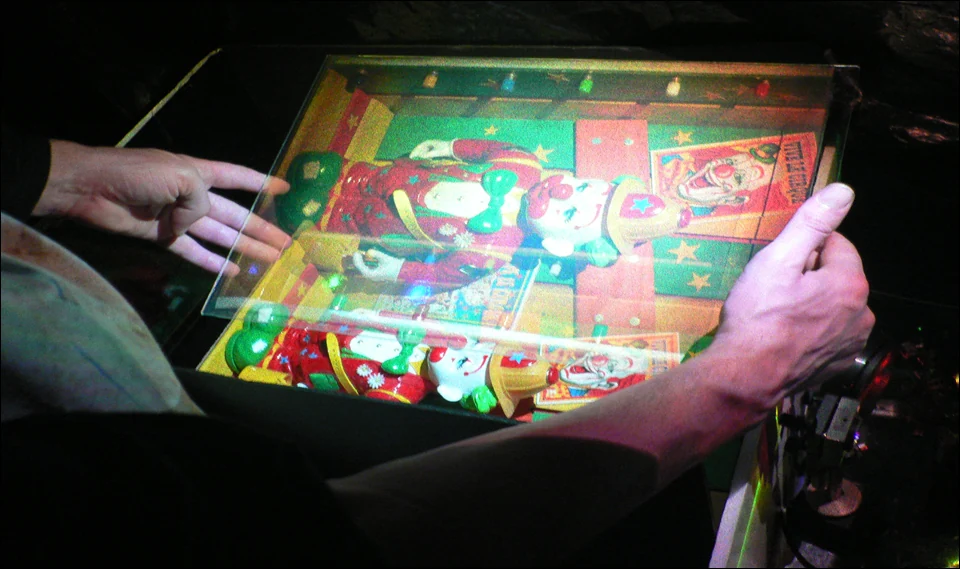
A flat recording can recreate light from a three-dimensional scene. Explore interference, wavefront reconstruction and parallax through transmission, reflection and rainbow holograms.
Image: Holopro · Source · CC BY-SA 4.0. Photograph of a colour hologram by Yves Gentet; a separate example from the named artworks.; viewing previews may be resized.Explore section →
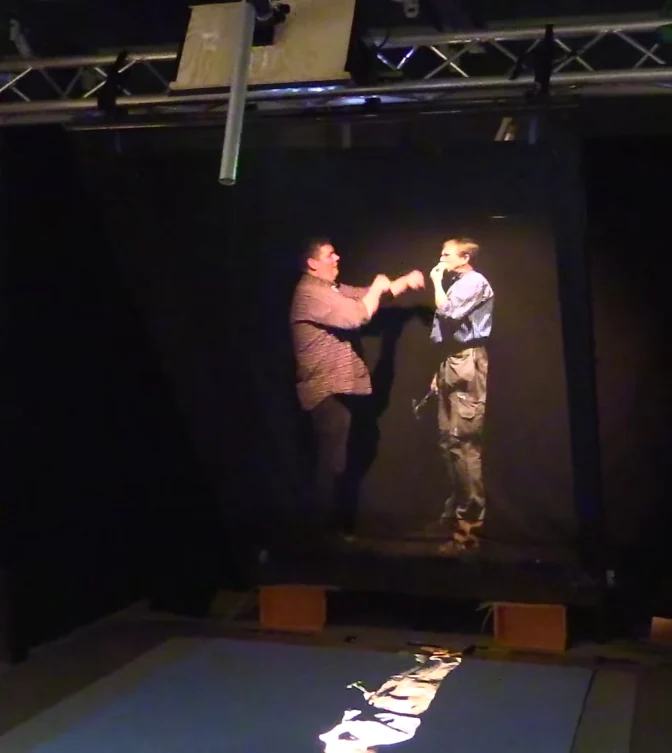
From ghost-lantern shows to reflected performers, endless mirrors and changing façades. Follow the light behind apparent presences, repeated reflections and projection mapping.
Image: Riksutställningar / Swedish Exhibition Agency · Source · CC BY-SA 3.0. Photograph of a Pepper’s Ghost workshop display using a video screen.; viewing previews may be resized.Explore section →
Frequently asked questions
How does optical holography record depth?
An object wave interferes with a coherent reference wave in a recording material. The resulting pattern encodes amplitude and relative phase. Suitable illumination is diffracted by the developed hologram to reconstruct a wavefront, allowing different perspectives within its viewing zone.
Do all holograms need a laser for viewing?
No. Gary Fisher’s Optical Interactions is a laser-viewable transmission hologram. Reflection holograms, such as Matthew Schreiber’s Cassadaga (Spirit Pond), and rainbow holograms can be displayed with suitable white light. The required illumination depends on how the hologram was made.
Why does a rainbow hologram change colour when you tilt it?
Its structure sends different wavelengths in different vertical directions. Moving vertically changes the spectral colour reaching your eyes. Rainbow holography restricts vertical parallax while preserving side-to-side perspective, allowing an image with depth to be viewed in white light.
Are stage holograms the same as optical holography?
Optical holography encodes and reconstructs a light wavefront using an interference pattern. Pepper’s Ghost and Musion Eyeliner instead reflect an image into the audience’s view, making it appear to occupy the stage. Both can create a convincing presence, but their optical mechanisms differ.
How does an infinity LED mirror create depth?
A row of LEDs sits between a rear mirror and a partially reflective front panel. Repeated reflections create successive virtual images that appear farther away. Each loses light, so the apparent tunnel fades even though the frame is shallow.
Which Gorillaz performance used Musion’s system?
Musion documents Gorillaz at the November 2005 MTV Europe Music Awards in Lisbon and lists the band’s 2006 Grammy Awards appearance in its portfolio. Eyeliner uses angled transparent foil and video imagery to create the stage illusion.
How is projection mapping related to trompe-l’œil?
Projection mapping aligns light with a real object or building. Content that adds convincing perspective, shading or motion can turn that surface into a trompe-l’œil: it seems to gain depth or change shape. URBANSCREEN’s 555 KUBIK is an architectural example.
Was Madonna herself a hologram at the 2006 Grammys?
Her first appearance alongside Gorillaz was prerecorded footage presented through Musion’s reflected-video system. Musion director James Rock described filming it three weeks before the show. The performance then moved to Madonna appearing live with her dancers, so it combines a virtual appearance with a real performer.